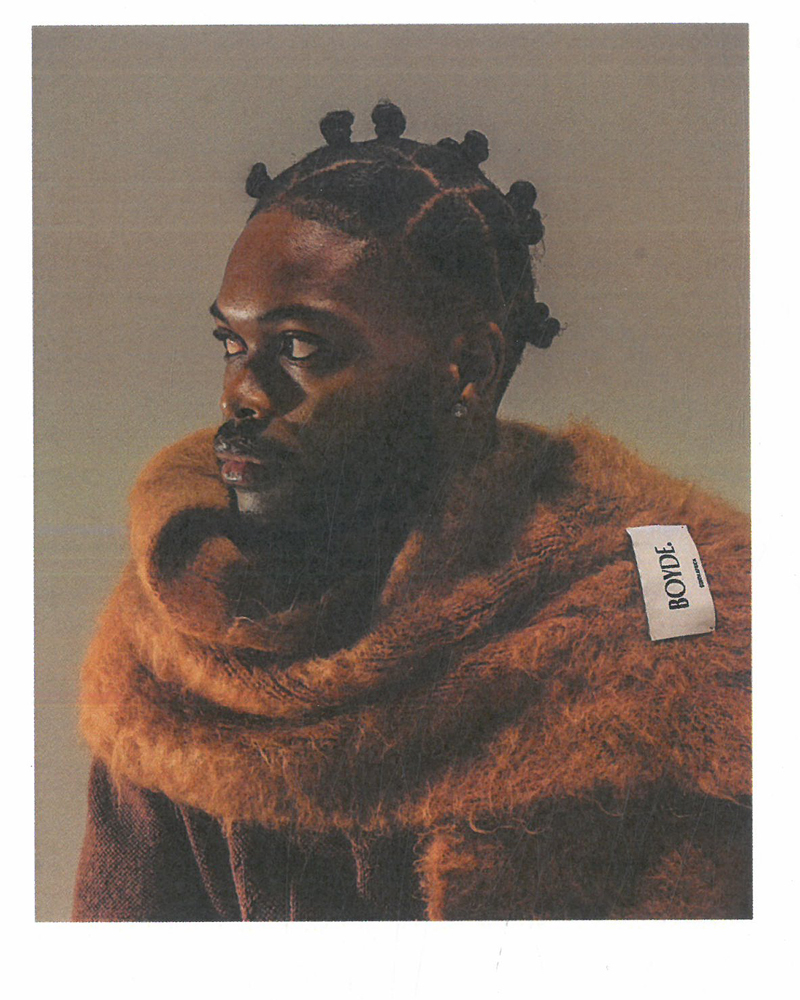
At this year’s Young Directors Awards (YDA) in Cannes, France, Matt Miller, President and CEO of AICP presented two Emerging Voices Grants - each in the amount of $15,000: The Women's Voices Career Grant and the Underrepresented Voices Career Grant, awarded to a YDA winner from a historically underrepresented background in directing professions.
The grant recipients were selected from among the winners of the YDA. One of the recipients is Lunga Mthombeni - a.k.a. Steezus, who won a Silver Honor in the YDA in the Passion Project category for “Love Thy Nation,” produced by Chris Coetsee and Steezus through Dare Content.
These grants, from the funds collected to foster these goals, and managed by the DGA Commercials Qualification Administration, together with a mentoring component, are intended to support women and people from other historically underrepresented groups by widening their opportunities to develop careers in the directing craft.
Steezus is a South African writer and director focused on character-driven filmmaking rooted in truth, cultural reimagination, and the exploration of human relationships. The Q+A below provides insights and thoughts from Steezus on his craft, creativity and developing his voice as a filmmaker.
How did you get into filmmaking? How did you learn the craft?
It was never really one moment for me. In fact it was a number of reaffirming moments. I guess it all starts as interest, I would assume like most people. I used to collect movies on a hard drive my cousin gave me that I would binge on my first laptop back in high school. I remember almost memorizing the entire scripts of “Good Will Hunting,” “Dead Poets Society,” and “The Great Gatsby.”
My English Teacher made a comment when sharing feedback from our essays that I have the mind of a director. That was a moment of confidence because since then I took it seriously. I then started documenting a close friend who wanted to be a musician, shot his music videos at home which is all so cool looking back because he is a very big musician right now.
In learning the craft, I have always watched all my favorite films/shorts that I would then reverse engineer until I understood how they were able to make that sequence that made me feel a certain way. How the shot + edit + sound would work together in that exact moment to ignite something in me. I would then try it myself while documenting [South African amapiano and hip-hop artist] Focalistic in varsity until I would get it right. This is all before I even learned that the industry standard is software like Premier Pro. I was literally making trending videos using Windows Movie Maker. I would work twice as hard because you couldn't have more than one layer, so I had to export the video, edit the exported video and so on to manipulate sound and pace. My life was never the same when I found out about Premier Pro.
Doing all this while documenting a musician forced me to understand music and sound on a deeper level. The studio sessions were the best because I wasn’t just an observer, over time, I also became a participant. Those kinds of moments show you how collective energy can impact a project. I would take what I learn from the sessions and feedback into the edits. I started asking for the audio stems because I wanted to give the video the feel I got when the producer was building the arrangement for the songs.
How long have you been a director? When did you start using the name Steezus?
I [have been a director for] three years professionally now. I became a director when I finished my first Film “Are You Happy?” in 2023 and that got recognized with a Silver at the 1.4 awards. Which also led me to direct a Spanish film in Spain titled “Ombres Silencioses” in 2024. This was a very challenging experience because of the language barrier. It was also this project that taught me that the human experience can transcend language. I don’t think in English, and neither did my crew. But it was our common love for the craft that helped us communicate.
Steezus came up in high school. But I never gave it to myself. I have always been given nicknames growing up and they would evolve based on something I did. With Steezus, I hosted a “Yeezus” listening party and took people through each song and at the end a friend called me Steezus. I only stuck with it because I’ve been using it as my IG handle.
How would you describe your style?
Every time someone asks me this question I kind of glitch. I don’t want to be boxed [in]. [The director] Angelo Cerisara once said: “It’s very easy to understand what you don’t like, but understanding what you like, as a director, that’s the most difficult thing.” He’s right and what I’d say I like so far is that my style draws from real and complex characters. I like to cast the actual person the story belongs to or write a character - maybe story - based on an actual person. I then try to create pockets that can fit in between that story. These pockets tend to test the truth or relationship. I also come from a musical background, so I believe in a well-crafted score. All my work has leaned into that, and I want to be able to test the boundaries of instruments. Pace and rhythm govern the feel. Sometimes I will use an instrument to the max in an unexpected moment to try and blend genres/feelings. This approach is best seen/felt in my first film because I had the privilege to craft something from scratch.
I also like playing with different formats. I wanted to mount old school video recorder lenses on an Arri Alexa for the YDA film but we had limited resources to do that. That's something I do a lot in my photography so I wanted to lend some of that flavor into this. I think the more you play and have fun within passion projects, the more you can find new tastes and create some refreshing looks.
I think my style is also growing as my career grows. The more I get exposed to different places, people, conversations and a “higher” level of thinking, the more I push my characters and the worlds I try to build. I think as I grow, I am also beginning to trust my audience more and challenge them instead of spoon feeding them.
What attracted you to advertising content?
World building. The idea that in just 60-90 seconds you can create a believable and convincing world to communicate a message is so inspiring to me. Especially if you are privileged to do this consistently. I have learned that directing is a privilege no matter where you are from. So I am grateful to have known about the possibilities of advertising content.
Please tell us about the piece that won at the Young Directors Awards (YDA). Where did the concept come from?
It all first started when I won the 1.4 Award. I made a good film that was just over 10 minutes long and I couldn’t successfully show agencies to help me get considered for boards, so I knew that my next piece had to be short. But It was only until about two weeks into my Spanish trip that I felt homesick and I started writing a love letter home. In that love letter, I also wrote about things I hate about home. In identifying all the things that I hate, I found myself understanding the humanness in them and how we can celebrate that. I titled it “Noma Yini.”
It was around September 2024 where I started storyboarding. My goal was to unite different South African brands under the theme “Noma Yini” as part of their CSR/CSI KPI’s, and we could make a huge and direct impact on the people the film focuses on. Using the film as the vehicle to drive this impact. So I put a list together, a deck and sent out emails. I was very fortunate to have responses from big companies but eventually only LTN (Love Thy Nation) was serious, so we went on to make the film. I still feel like this can make way for something bigger. Not just for me, but for the waste surfers we see on the roads, the homeless guys who direct traffic at the intersections and for kids who need support.
I was reimagining all the nuances that a lot of South Africans overlook. The goal was to make the waste surfers look cool, hip and aspirational. I wanted to make a film where younger South Africans can look at these characters and want to be more like them. I wanted to make recycling cool, the same way rap and fashion is cool. Hence, you’ll see customized plates on the trolley, some makeshift jewelry worn by the two surfers and the well-spoken-ness of them.
Who inspires you?
My mother was the first person who I knew and saw make things out of nothing. She is the person to teach me that I can conjure up worlds where there are none and so naturally, she inspires me.
In the context of the Noma Yini film, I’m inspired by Banele, a Soweto-born youth who is making recycling and sustainability fashionable in his township. I am inspired by Moruti, a white kid who grew up in Tembisa and is fluent in all African languages… all real-life stories that I’ve not only pulled from but used as characters in the film.
On a global level; Ray Dalio, Andy Warhol, Onda, Akinola Davies jr, Virgil Abloh, Pharell Williams, Stormzy, and so many more. I think there’s a lot of beauty in the world and inspiration can come from anywhere.
How will the AICP Emerging Voices Grant help your career?
At the most immediate, and perhaps most important level, the grant will act as an affirmation that I’m on the right path. I have deep trust and belief in my craft, but the external nod of approval makes the journey less daunting; there are people who see me. My work and my voice matters. The further backing and support from AICP, YDA, and the DGA will help build credibility and trust with agencies and production companies.
Every project I have created to this point has been done out of sheer passion and dedication. Therefore, outside of the significance of the recognition on a personal level, the grant gives me access to resources that allow me to continue pursuing narratives that I strongly believe in, while sharpening my eye and taste as a director.
If all goes well, I also hope to use the grant to live in Europe for a while. Connect with creatives, develop relationships and focus on growing a lot of the leads I have garnered over social media because I believe that it’s the human experience that creates meaningful, lasting work.
What are your plans for the future?
To continue looking and observing. This might sound slightly sensational however, there’s no sincerity in storytelling and an established emotional connection to things if one does not really look.
I want to keep my eyes open to not only the real stories around me but to the diverse creatives, makers, and even brands and entities that share a sense of commitment to building worlds that carry depth and strong perspectives. I am also working on my first feature film script which I hope to bring to life with help from international producers and get through Sundance.
I am always tentatively working on a new story/idea, my plan is to position myself to be able to tell important stories that best represent where I am from to the diaspora. I hope to be the bridge that brings African stories to the world that can inspire positive change and entertain people.
Anything else you’d like us to know about you and your work?
I am a very passionate and sincere filmmaker. I have a very strong work ethic. I take my work seriously especially if I am working on something that keeps my fire burning. I know I haven’t even made my best piece yet, everything I have done was really just me being resourceful and strategic (to a certain extent). I believe there is so much more I can do and I cannot wait to share my light with the world.
Africa has been heavily influenced by the rest of the world in so many ways. Fashion, Sport, Music, Food & Lifestyle. I hope to one day make ads for African consumers of international brands/products. Localizing the taste with an internationally considered palette is a benchmark for a renaissance in filmmaking. These ideas need backing, so for now, I will continue to do what I can with what I have to the best of my abilities while keeping the message strong.
For more information about the YDA and AICP Emerging Voices Grant, please contact info@aicp.com.